
Miela Demo: How an AI-Assisted Creator Campaign Works from Discovery to Final Report
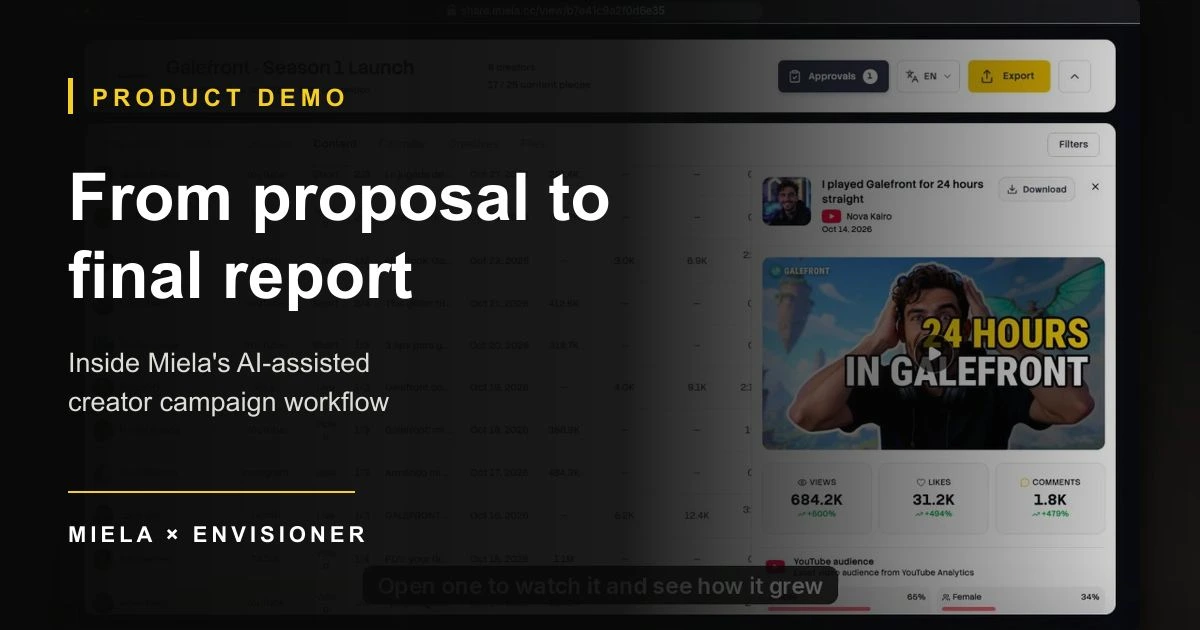
Miela product demo

Chief Marketing Officer
Watch Miela's five-minute demo of creator discovery, scoring, Aria, branded assets, approvals, live reporting and campaign operations, and learn how the workflow fits together.
A creator campaign involves much more than choosing a few influencers and waiting for their posts. Behind every activation there is research, audience analysis, negotiation, briefing, asset production, approvals, tracking, payments and reporting. When those steps live in separate spreadsheets and inboxes, scale creates operational friction instead of better marketing.
Miela's new product demo shows how that workflow can operate as one connected system. In five minutes and eleven seconds, the video moves through creator discovery, scoring, campaign proposals, Aria's AI-assisted coordination, branded assets, the creator portal, approvals, live reporting, optimization, fraud controls and back-office administration.
The demo uses a fictional activation called Galefront Season 1 Launch to illustrate the interface. Its creators and campaign figures are demonstrative, not client results. The value of the video is the workflow itself: how information moves from the first creator search to the final report without losing the context needed to make decisions.
Discovery starts with communities, not celebrity status
The first stage shown in the demo is creator supply. According to the video, Envisioner indexes more than 11 million profiles across eight platforms. That scale is useful only if it helps a team find relevant people. A campaign does not need the largest possible list. It needs creators whose content, audience, geography and format fit the objective.
This distinction is especially important for brands entering niche communities. A mid-sized gaming streamer can have a closer relationship with viewers than a general entertainment account with several times the reach. A specialist trading creator can generate more informed questions than a broad lifestyle profile. The selection problem is therefore not simply who is famous, but who is credible within the conversation a brand wants to join.
The discovery workflow brings those candidates into one environment. Instead of rebuilding a list from scratch for every campaign, the team can evaluate profiles, platforms and audience signals together. Human review remains essential: data can narrow the field, but brand fit, tone, cultural context and content quality still require judgment.
Scoring turns creator selection into an explainable process
Once candidates are identified, the demo introduces a creator score from 0 to 100. The example combines results for the price, content quality, on-time delivery and setup. It also shows campaign priority through creator tiers. The objective is not to reduce a creator to a single number. It is to make comparisons more consistent and the reasons behind a recommendation easier to inspect.
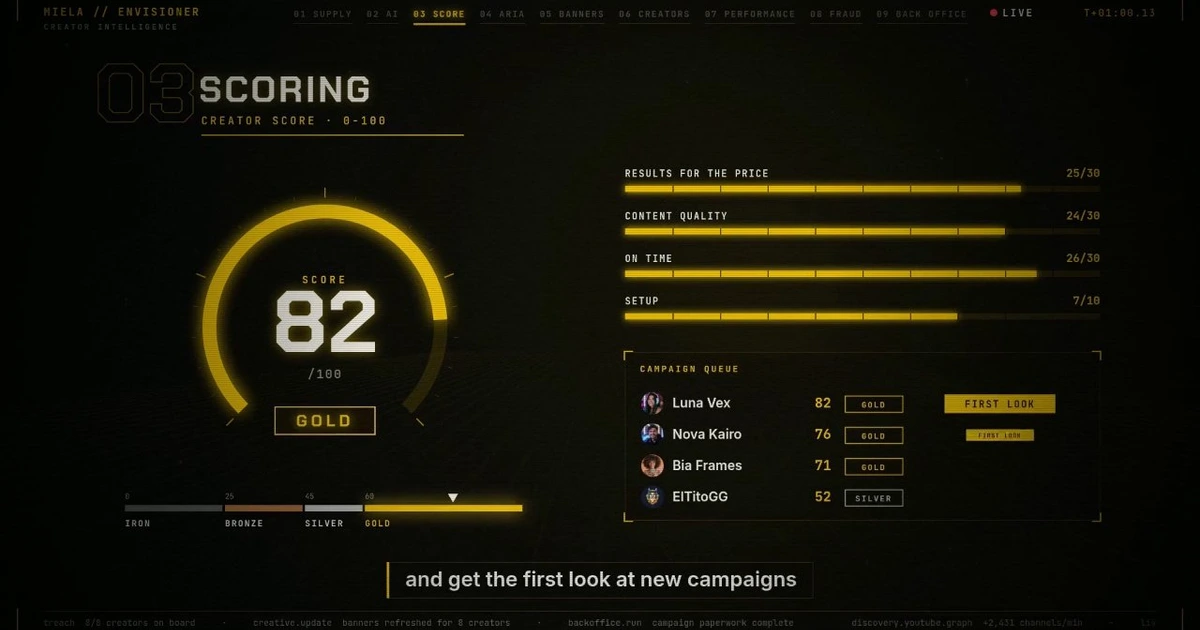
Creator scoring interface shown in Miela's product demo
A useful scoring system should answer practical questions. Does this creator reach the right countries? Are views consistent across recent content? Does the audience respond naturally? Has the creator delivered on time? Does the proposed fee make sense for the expected outcome? Is the channel prepared for the technical requirements of a live activation?
This approach also makes room for smaller and mid-sized creators. Follower count alone tends to favor accounts with broad visibility. A broader evaluation can surface niche streamers and influencers whose communities are smaller but more relevant. For Miela, scale means coordinating many of those relationships without losing individual briefs, rates, deadlines or performance histories.
The proposal connects deliverables, rates and campaign economics
After selection, the workflow becomes a concrete campaign proposal. The demo shows creator lineups, content pieces and pricing organized in one place, with PDF and Excel exports for review. This is where strategy becomes an operating plan: who will participate, what each person will publish, when it will happen and how the budget is distributed.
Separating prices by deliverable matters. A live stream, a long-form video, a short clip and a story require different production effort and create different kinds of value. Treating them as interchangeable makes both planning and measurement weaker. A clear proposal gives the brand a useful baseline for approval and gives the creator an unambiguous scope.
The proposal also creates the structure needed later for reporting. If every creator, format, rate and date is defined at the beginning, delivered content can be compared with the original plan rather than reconstructed after the campaign.
Aria coordinates the repetitive work around the campaign
The next section introduces Aria, Miela's AI agent specialized in influencer marketing. In the demo, Aria supports multilingual outreach, brief delivery, scheduling and reminders. The campaign board shows creators, dates and deliverables together, making it easier to see what has been completed and what needs attention.
The practical role of AI here is operational. It can prepare a first outreach draft, adapt communication to another language, send a brief, follow a schedule and flag a pending delivery. Those are necessary tasks, but they do not define the campaign's strategic value. Objectives, creator fit, budget, creative direction and approval limits still belong with the team.
That division is what makes automation useful. The system keeps the process moving while people concentrate on decisions that require context. It also creates a more consistent experience for creators, who receive clearer instructions and know which deliverable is expected next.
Brand kits turn guidelines into usable campaign assets
Creator marketing depends on authenticity, but it still needs brand consistency. The demo shows a brand kit containing campaign assets such as overlays, banners and story materials. For live campaigns, this can include the visual elements a creator needs for their stream and channel description.
Centralizing those assets reduces a common source of errors: creators using outdated logos, broken links or different versions of a promotion. When a campaign changes, the relevant materials can be updated in the same workflow rather than chased through separate message threads.
The objective is not to make every creator's content look identical. The creator's voice remains the reason the collaboration exists. The brand kit provides a consistent frame around that voice, together with practical instructions on logo use, links, disclosures and campaign requirements.
The creator portal keeps delivery and approvals in one place
The demo then moves to the creator side. Through the portal, creators can review campaign information, access materials, manage deliverables and follow administrative steps such as contracts and payments. This shared environment reduces the gap between what the brand team sees and what the creator believes has been agreed.
Approvals are part of the same flow. The video demonstrates feedback linked to a specific moment in a piece of content, allowing a reviewer to identify exactly where a change is needed. That is more useful than a generic request to revise a video because it connects the comment to the relevant second and context.
A structured approval process also protects the relationship. Creators receive actionable feedback, while brands retain a record of what was reviewed and approved. The goal is to resolve issues before publication, not to add another layer of bureaucracy.
Live reporting brings content, audience and outcomes together
Once content is published, the reporting view gathers campaign activity into a single dashboard. The demo shows deliverables, views, likes, comments, watch time, clicks and audience information. It also presents connections with platform data from YouTube, TikTok, Instagram, Twitch and Kick, alongside audience breakdowns by country and age where available.
This changes the reporting rhythm. A team does not have to wait for a collection of screenshots at the end of the activation to understand what is happening. It can review delivery and performance while the campaign is active, compare formats and identify content that deserves further distribution or a different approach.
For live streaming, the video describes recurring stream checks every five minutes. The purpose is to make live activity visible within the reporting workflow rather than treating a stream as a black box measured only after it ends. As with every platform integration, the available metrics depend on the connected account, permissions and data exposed by each platform.
The Galefront figures shown in this part of the video are sample data. A real campaign report would use the brand's actual connected sources, agreed attribution and verified campaign activity.
Optimization depends on the business objective
A dashboard is useful only if it supports a decision. The demo distinguishes optimization for branding, conversions, revenue and retention. Those objectives require different readings of the same activity.
A branding campaign may prioritize qualified reach, video completion, audience relevance and sentiment. A download campaign needs tracked clicks, installs and cost per acquisition. An iGaming or trading activation may focus on verified first-time depositors, acquisition cost and subsequent quality. A retention objective asks whether the acquired users remain active after the initial response.
This is why Miela connects content-level metrics with campaign outcomes. Views provide context, but they are not a universal definition of success. The report should make it possible to understand which creators and formats contributed to the result the brand actually wanted.
Fraud controls and back-office work protect the operation
The final part of the demo addresses two areas that rarely appear in promotional campaign videos: data quality and administration. The fraud shield illustrates checks on audience and performance signals so suspicious patterns can be reviewed before numbers are treated as valid outcomes.
No single automated signal should be presented as universal proof of fraud. The useful approach is to combine platform data, historical patterns and human review, then document any exclusions or adjustments. That makes reporting more defensible and helps protect budget from low-quality activity.
The back-office view connects contracts, compliance, invoices and payments to the campaign. This matters because a campaign is not truly finished when the last post goes live. Deliverables must be confirmed, documentation completed and creators paid according to the agreed terms. Keeping those steps close to campaign data reduces administrative ambiguity for both sides.
What the final report should help a brand understand
A strong final report should do more than total impressions. It should explain what was planned, what was delivered, which audiences responded, how each format performed and what happened after the content interaction. It should also separate verified data from estimates and make any measurement limitations visible.
For creators, the same structure provides a clear record of deliverables and performance. For brands, it creates a basis for the next decision: repeat a partnership, adjust a format, enter another community or change the objective. Reporting becomes part of the learning process rather than a file archived at the end of the month.
Frequently asked questions
Does the demo show real client campaign results? No. Galefront Season 1 Launch is a fictional example used to demonstrate the product workflow. The creators and figures in the demo are illustrative and should not be interpreted as results achieved for a client.
Does Aria replace campaign strategy? No. Aria supports operational work such as outreach, briefs, schedules, reminders and reporting. The team still defines objectives, evaluates brand fit, directs the creative approach, sets budgets and reviews decisions.
Can small and mid-sized creators participate in this model? Yes. The workflow is designed to evaluate audience fit, content quality, reliability and expected value, not just follower totals. This makes niche creators relevant when their communities match a campaign. Registration or inclusion in discovery does not guarantee a paid offer.
Which metrics can a brand review? Depending on the campaign and available integrations, reporting can include deliverables, views, likes, comments, watch time, clicks, audience geography and age. Conversion campaigns can also connect tracked actions, acquisition costs and business outcomes through the agreed measurement setup.
Miela Insight
The most important idea in the demo is not that AI can produce more campaign activity. It is that discovery, coordination, assets, approvals and measurement can share the same operational context. That is what allows a team to work with many niche creators while preserving individual attention and clear accountability.
Miela combines that technology with campaign strategy, creator relationships and vertical expertise in gaming, iGaming, sports and trading. To discuss how this workflow could apply to your next activation, contact us today. Creators who want to be considered for future paid opportunities can create their profile on Miela Creators.
Sources
Envisioner: creator campaign technology
Related Articles

GTA 6's 'The Festival' Launch: A New Benchmark for Gaming Brand Activations
Rockstar confirmed GTA 6's launch event is called 'The Festival', the biggest gaming launch of the decade. CMOs get insights on brand opportunities, infrastructure risks and creator strategy.
Miela Reaches #1 in Content Marketing and Branding in Chile on Clutch
Miela rises from #3 to #1 in Content Marketing and from #2 to #1 in Branding on Clutch, and from #5 to #4 in Digital Marketing on The Manifest.
Worlds 2026 First Semifinal Draws 2.19M Peak Viewers, Gen.G Books Grand Final Spot
First 2026 Worlds semifinal reaches 2.19 million peak viewers as Gen.G sweeps LYON to advance to the grand final, eliminating NA’s last team.