
OpenAI Changes ChatGPT Pro: A $500 Plan and Less Included Usage on Pro 200
Miela editorial graphic

Chief Marketing Officer
ChatGPT adds Pro 500 at $500 a month as eligible Pro 200 users face lower allowances from October 30. What it means for creators and marketing teams.
OpenAI is changing the economics of its premium ChatGPT subscriptions. The company introduced Pro 500 at $500 a month on September 29, while confirming that eligible existing Pro 200 customers will move to a lower included usage allowance after October 29. The $200 monthly price stays the same.
For creators, agencies and marketing teams using ChatGPT Work and Codex to produce briefs, research audiences or build campaign tools, the practical question is how much finished work a subscription covers. A monthly fee alone no longer tells the whole story.
What changes on October 30
OpenAI's Pro plan documentation confirms that qualifying Pro 200 subscribers retain their previous allowance through October 29, 2026, while their subscription remains active. Eligibility covers accounts with an active Pro 200 subscription at any point from September 22 through 10 a.m. Pacific Time on September 29. New subscriptions outside that window already receive the lower allowance.
The Next Web reports that the October 30 transition reduces included ChatGPT Work and Codex usage from 20 times to 10 times the Plus allowance. GPT-6 Pro messages in Chat fall from 200 to 100 per week. These are specific allowance changes, not a claim that every ChatGPT feature has been cut in half.
For someone who regularly used the full previous Work and Codex allowance, this means less included capacity for the same subscription payment. It does not guarantee that every workflow will cost twice as much: model choice, task complexity and the amount of revision still determine how much work gets completed.
The three Pro subscription prices
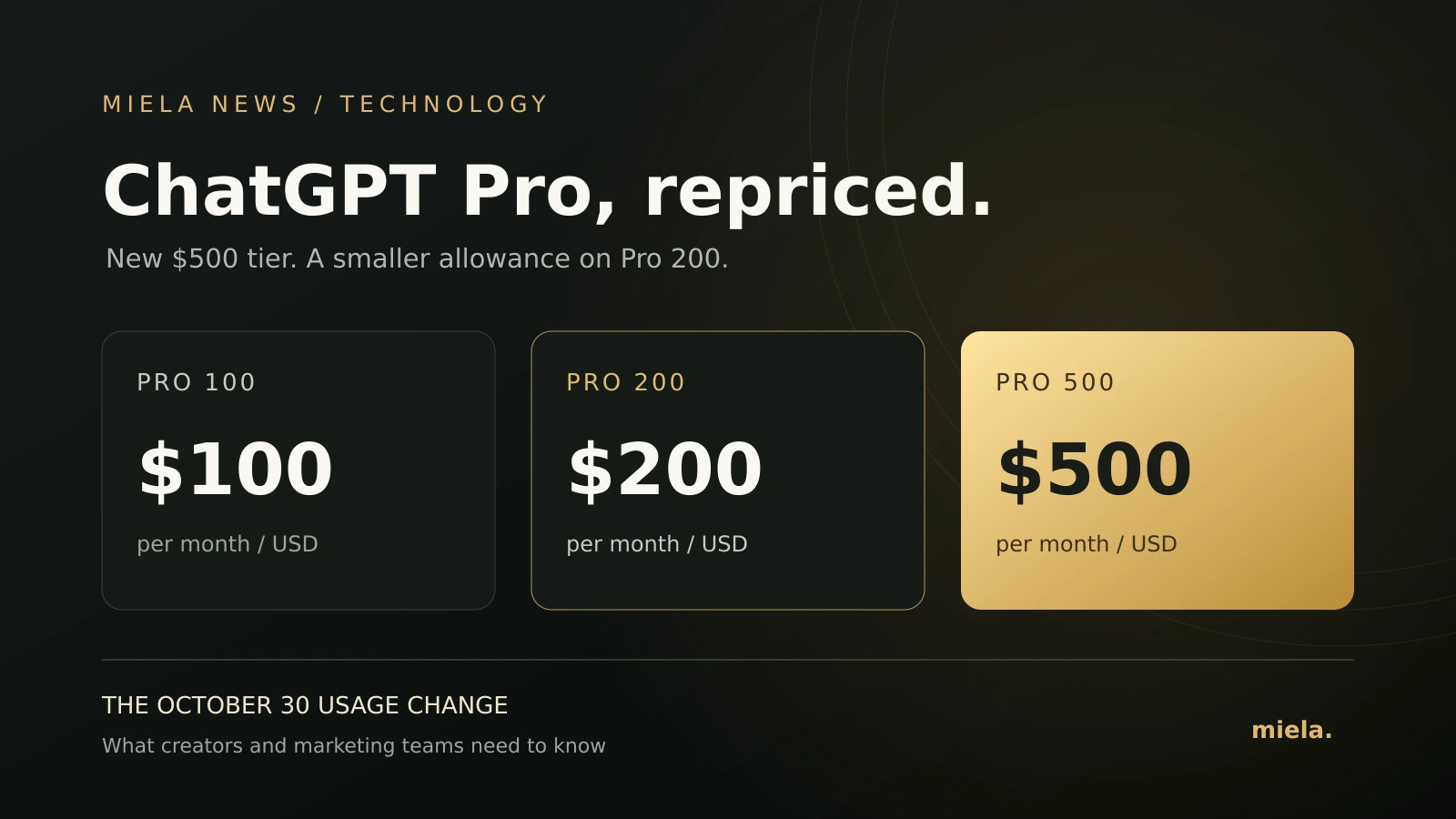
OpenAI lists the following monthly prices in USD, checked on October 3, 2026:
Pro 100: $100 per month. The entry Pro tier. Astra Ultrafast is not included.
Pro 200: $200 per month. More included usage than Pro 100, with the transition described above for eligible existing subscribers. Astra Ultrafast is not included.
Pro 500: $500 per month. The highest included usage among Pro plans and access to Astra Ultrafast in ChatGPT Work and Codex. Buying extra credits on Pro 100 or Pro 200 does not unlock that speed tier at launch.
The jump from Pro 200 to Pro 500 adds $300 a month, or $3,600 over twelve months if retained throughout that period. That is a budgeting calculation, not an annual billing offer: Pro is billed monthly. Check the account checkout for the applicable local price and taxes.
Ultrafast comes with a usage tradeoff
OpenAI's usage guide says GPT-6 Astra Ultrafast consumes included subscription allowance at eight times the Standard rate for the same model. Purchased credits use a different multiplier: six times Standard. Those figures describe consumption, not a promise that an entire project finishes eight times faster.
Pro plans currently have no five-hour limit, according to the same guide. They still have usage constraints. ChatGPT Work and Codex share an allowance, so moving a task between those products does not create a second budget.
Transition credits are temporary
Normal Like Peter's review of subscriber notices documents a one-time grant of 62,500 usage credits, described as $2,500 in usage value, expiring December 31, 2026. The Next Web also reports the credit offer. This is reported support for affected subscribers, not a universal entitlement for every ChatGPT account or a cash refund. Subscribers should verify their own notice, balance and expiry.
Temporary credits can soften the transition, but they should not be counted as recurring capacity in next year's campaign budget.
What creator and marketing teams should do
Before changing plans, review a representative week of work: briefs completed, localized copy approved, reports delivered and time spent correcting outputs. Compare those results with the allowance consumed. Keep routine formatting and first drafts separate from tasks that need extensive research or sustained reasoning.
For an agency, the useful measure is cost per approved deliverable, including human review. A faster model can help on a deadline, but paying for speed has less value when the next bottleneck is client feedback or creator availability. Teams should also distinguish individual Pro subscriptions from Business or Enterprise workspace purchasing.
Miela Insight
Our view: AI subscriptions now deserve the same operational attention as media spend and production software. Build campaign estimates around repeatable workflows and measured capacity, then keep room for exceptional work. A temporary credit balance should not become the basis for a permanent client promise.
For creator campaigns, the goal remains useful output: a clearer brief, better market research and faster preparation for a human creator. The right plan is the one that supports that work consistently at a cost the team can explain.
Planning your next creator campaign? to discuss your goals.
Sources
OpenAI: pricing and usage limits
OpenAI: September 29 release notes
The Next Web: Pro 200 usage changes and the Pro 500 launch
Normal Like Peter: subscriber notices and transition credits
Related Articles

OpenAI Launches ChatGPT Images 2.5
OpenAI's ChatGPT Images 2.5 brings sharper detail, multi-turn precision editing, Sketch, templates and two new API models (Flare and Sunburst).

Henkel's Oriol Marín
Henkel Consumer Brands Ibérica's marketing director explains how the 150-year-old company uses data, AI and automation to elevate brand building.

AI Is Changing Influencer Marketing, But Human
Artificial intelligence is transforming influencer marketing through automation and analytics, but human creativity, trust.